
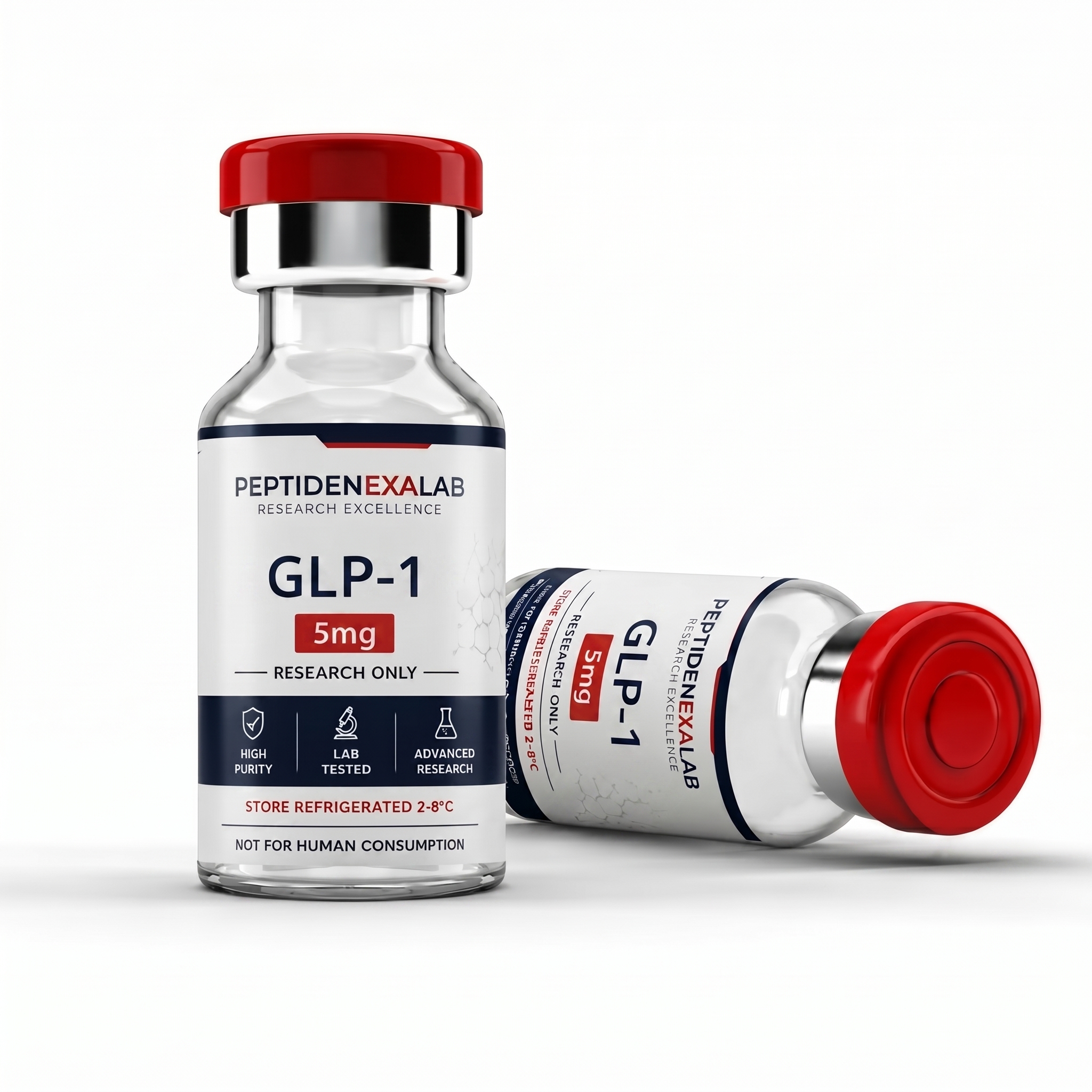
GLP-1 (Glucagon-Like Peptide-1) is a 30-amino acid incretin hormone derived from the proglucagon gene, secreted by intestinal L-cells in response to nutrient ingestion, that acts via the GLP-1 receptor (GLP-1R) to stimulate glucose-dependent insulin secretion, suppress glucagon, slow gastric emptying, and reduce food intake — supplied by Peptides Lab UK in lyophilised format at >99% purity (HPLC verified) for in vitro and pre-clinical laboratory research use only.
What is GLP-1 (Glucagon-Like Peptide-1)?
GLP-1 is a 30-amino acid peptide hormone produced by differential post-translational processing of the proglucagon precursor protein by prohormone convertase 1/3 (PCSK1) in intestinal L-cells and in neurons of the nucleus tractus solitarii (NTS) in the brainstem. The proglucagon gene encodes a 180-amino acid precursor that, depending on the tissue-specific expression of processing enzymes, yields different active peptides: in the pancreatic alpha cells, PCSK2 processing produces glucagon; in the intestinal L-cells and brain, PCSK1 processing produces GLP-1 and GLP-2 as part of a larger proglucagon fragment.
The primary bioactive form of GLP-1 is GLP-1(7–36)amide — a 30-amino acid C-terminally amidated peptide. Smaller amounts of the non-amidated GLP-1(7–37) are also produced. Both forms are biologically active at the GLP-1 receptor, though GLP-1(7–36)amide is the predominant circulating form in published pharmacokinetic literature. A key challenge in studying native GLP-1 is its extremely short in vivo half-life of approximately 1–2 minutes, owing to rapid inactivation by dipeptidyl peptidase-4 (DPP-4), which cleaves the N-terminal His-Ala dipeptide from GLP-1 to produce the inactive metabolite GLP-1(9–36)amide. This rapid degradation is the primary reason that GLP-1 receptor agonist drugs require structural modifications — such as DPP-4 resistance mutations, albumin binding, or Fc fusion — to achieve a pharmacologically useful duration of action.
GLP-1 is released from intestinal L-cells in a biphasic pattern following meal ingestion: an initial early peak within 10–15 minutes, driven primarily by neural and endocrine signals from the upper gastrointestinal tract, is followed by a sustained second peak at 30–60 minutes driven by direct nutrient contact with L-cells in the distal ileum and colon. Circulating plasma GLP-1 levels rise from approximately 5–10 pmol/L in the fasted state to 15–50 pmol/L in the postprandial state, with peak levels depending on meal composition, caloric density, and rate of gastric emptying.
GLP-1 – Key Research Facts
- Full name: Glucagon-Like Peptide-1 — incretin hormone of the proglucagon family
- Primary bioactive form: GLP-1(7–36)amide — 30 amino acids, C-terminally amidated
- Gene source: Proglucagon gene — processed by PCSK1 in intestinal L-cells and brainstem NTS neurons
- In vivo half-life: Approximately 1–2 minutes — rapidly inactivated by DPP-4 (cleaves His7-Ala8 dipeptide)
- Primary receptor: GLP-1R (GLP-1 receptor) — class B G protein-coupled receptor (GPCR)
- Signalling: GLP-1R activation → cAMP elevation → PKA/CREB activation → glucose-dependent insulin secretion
- Additional signalling: PI3K/Akt pathway — β-cell survival, proliferation, and glucose sensitivity
- Secretion pattern: Biphasic post-meal release from intestinal L-cells — early neural/endocrine peak + late direct nutrient-contact peak
- Fasting plasma level: ~5–10 pmol/L; postprandial peak: ~15–50 pmol/L
- Research significance: Native reference peptide for all GLP-1R binding, signalling, and incretin pathway studies — foundational molecule for semaglutide, liraglutide, and dulaglutide drug class
What Does GLP-1 Do in Research?
In laboratory and pre-clinical research settings, native GLP-1 serves as the primary pharmacological reference standard for studying GLP-1 receptor binding, activation, and downstream signalling — as well as the broader incretin axis and its connections to pancreatic β-cell biology, appetite regulation, gastric motility, cardiovascular function, and neuroprotection. GLP-1 research spans a remarkably broad range of biological systems owing to the widespread distribution of the GLP-1 receptor across multiple tissue types.
At the cellular level, GLP-1 binding to GLP-1R activates the Gs protein, stimulating adenylyl cyclase and increasing intracellular cyclic AMP (cAMP) concentrations. Elevated cAMP activates protein kinase A (PKA), which phosphorylates multiple targets including ion channels, transcription factors (notably CREB), and components of the insulin secretory machinery. In pancreatic β-cells, this results in enhanced glucose-dependent insulin exocytosis — the ‘incretin effect’ — and also drives insulin gene expression and β-cell survival and proliferation via the PI3K/Akt pathway. The glucose-dependency of GLP-1’s insulinotropic effect — it only amplifies insulin secretion when blood glucose is elevated — is a key pharmacological property that distinguishes GLP-1 from non-incretin insulin secretagogues in research models.
Beyond the pancreas, GLP-1R is expressed in the brain (particularly the hypothalamus, brainstem NTS, and reward circuitry), heart, kidney, lung, gastrointestinal tract, bone, and immune cells. This broad receptor distribution underlies the pleiotropic research profile of GLP-1 — from appetite and reward behaviour regulation in the central nervous system, to cardioprotective effects in cardiac tissue, to anti-inflammatory and immunomodulatory activity in immune cell models. The native GLP-1 peptide provides the most direct tool for interrogating all of these receptor-mediated pathways at source, without the confounding structural modifications present in GLP-1RA drug compounds.
Key Research Areas for GLP-1
- GLP-1R binding kinetics, receptor occupancy, and competition assays — reference ligand for GLP-1RA drug development
- cAMP/PKA/CREB intracellular signalling cascade studies in pancreatic β-cell models
- PI3K/Akt β-cell survival, proliferation, and apoptosis pathway research
- Glucose-dependent insulin secretion assays — incretin effect characterisation in isolated islet and β-cell models
- Glucagon suppression pathway studies in pancreatic α-cell and islet co-culture models
- DPP-4 degradation kinetics and GLP-1 metabolite (GLP-1(9–36)amide) pathway studies
- Central nervous system appetite regulation — hypothalamic GLP-1R signalling and energy homeostasis research
- Reward behaviour and dopaminergic signalling pathway investigations — hedonic eating models
- Cardiovascular pathway research — cardioprotection, heart rate regulation, and GLP-1R-positive cardiac cell studies
- Gastric emptying and gastrointestinal motility pathway studies — ‘ileal brake’ mechanism research
- Anti-inflammatory and immune cell GLP-1R signalling studies — T-cell, macrophage, and lymphocyte models
- Neuroprotection pathway research in neuronal cell models
- Comparative GLP-1 vs. GLP-1RA potency, duration, and receptor engagement studies
- Multi-agonist research context — GLP-1 as the reference arm in GIP/GLP-1 and GLP-1/GCG/GIP triple agonist studies
What Do Studies Say About GLP-1?
GLP-1 has one of the most extensive published research bases of any peptide hormone in modern biomedical science, with thousands of peer-reviewed studies spanning its discovery, physiology, receptor pharmacology, and the entire GLP-1RA drug class built upon it.



Reviews
There are no reviews yet.